
One island, several approaches
Khlong Khian’s local administration identifies Ko Phanak as an island under Ao Phang Nga National Park and names Bat Cave, Mangrove Cave and Climbing Cave among its features. It describes different forms of access, including canoe approaches and places involving movement above the water. These descriptions are a reason to ask for the actual route, rather than treating all cave visits as the same activity.
The Tourism Authority of Thailand’s 2018 Phang Nga brochure also describes Ko Phanak’s caves and rock formations. That historical description explains the island’s appeal, but does not establish the condition of an entrance today. A cave name in a brochure is not an assurance that the passage is accessible at the time your boat arrives.
Distinguish a canoe section from a walking section
A visit may involve remaining in a canoe, getting out for a cave section or changing plans when a passage is unavailable. Ask your provider which of those applies to the programme you are considering. If wet surfaces, low clearance or getting in and out of a small boat affect your choice, explain those concerns before booking rather than after reaching the island.
The local destination account describes both canoe-access caves and other approaches. It should not be read as advice to climb or walk into a cave independently. Follow the route made available by the guide and park staff that day. Do not enter a different passage simply because another group appears to be using it.

Let the operator explain the tide window
The important question is not whether Ko Phanak is generally described as open, but whether the intended passage can be used during your visit. Ask which cave the operator expects to reach, what alternative it uses if access changes and whether you will still have a worthwhile island visit if that particular passage is unavailable.
John Gray’s Sea Canoe publishes a Phang Nga Bay programme that names Panak and Hong as separate stops and explicitly says its itinerary may change according to the tides. That is useful evidence of how an operator plans around the water level. It is not a fixed entry window that can be applied to every boat trip, provider or date.
Clarify who paddles and where the transfer happens
John Gray’s published tour description says a guide paddles visitors through tidal caves from a supporting boat. Other programmes should be checked on their own terms. Ask whether your trip includes a paddler, whether any self-paddling is optional and how boarding and returning to the main boat are organised.
If travelling with children or someone who needs assistance, describe the practical requirements to the provider and ask about the specific canoe section. A general invitation to families does not answer every question about boarding, seating or the route. Obtain an explanation for your group instead of treating a promotional suitability statement as an individual assessment.
Read the two coastal photographs carefully
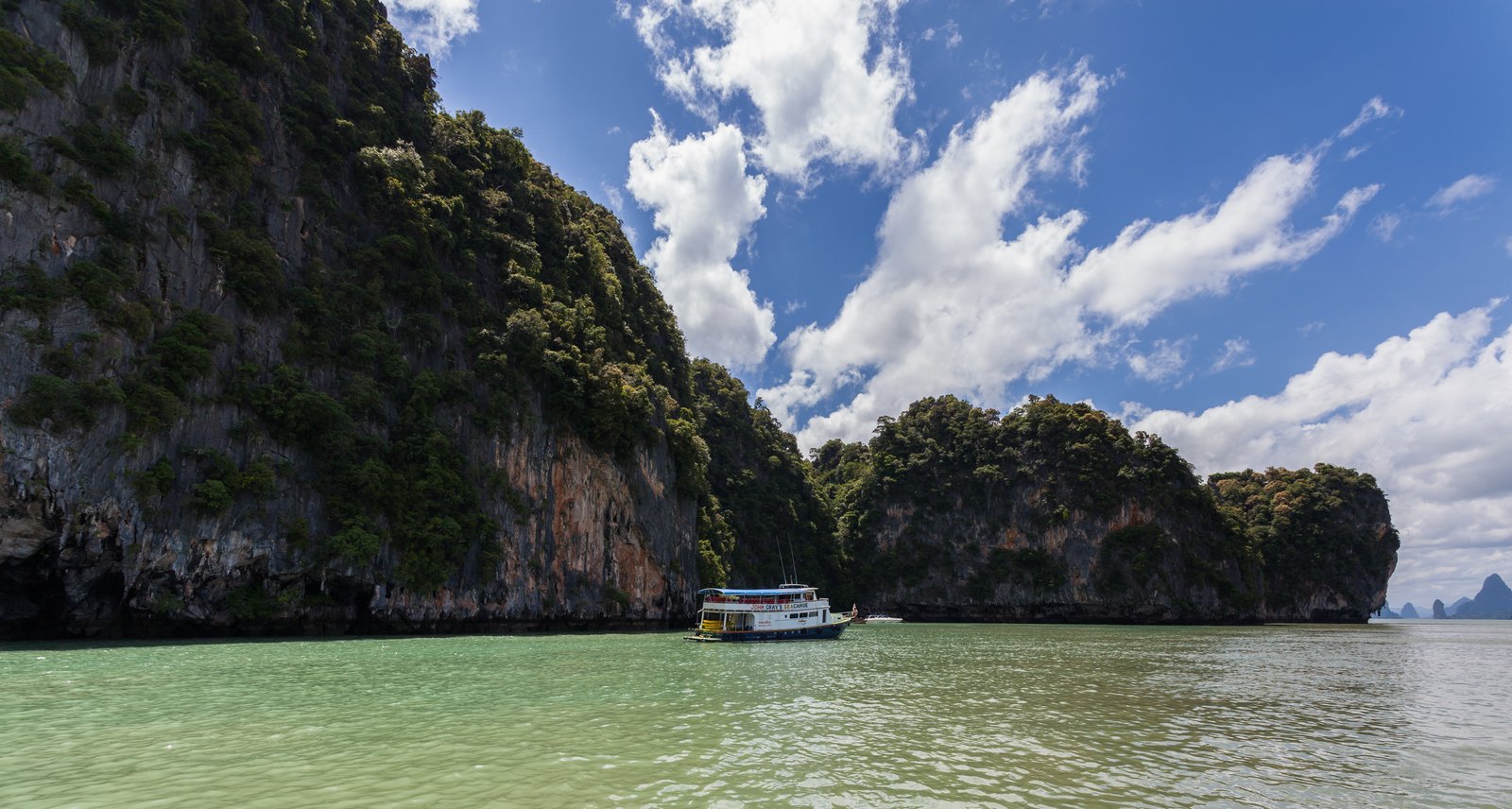
The photographs here were taken at Panak Island in August 2013. One shows small craft below the limestone walls; the other shows a larger boat outside the cliffs. They illustrate the difference in scale between travelling across the bay and approaching the island closely in a smaller craft.
They do not identify today’s canoe boarding point, the interior of a particular named cave or a current boat service. Ask the operator for the meeting and transfer instructions attached to your booking. A boat visible in an old photograph is not evidence that the same vessel or arrangement will be used for your visit.
Keep the departure and the other island stops explicit
The operator programme cited here departs through Ao Po in Phuket and includes transfers under its own published terms. It does not establish a pickup from a hotel in Khao Lak or elsewhere in Phang Nga. If you are staying on the mainland, identify the actual pier and the road connection offered by the provider you choose.
Ko Hong and Ko Phanak are separate island names, even when both appear in one itinerary. Check that the bay route and stops match your intended visit. For a return journey involving another appointment or an airport transfer, obtain the provider’s current return estimate for that exact programme. No fixed fare, cave entry time or guaranteed return time is quoted here.
Sources and visit details
Place and published operator information checked on 2 November 2026 (Thailand). The 2018 brochure is historical context; confirm current park access, the cave route and transport arrangements before departure.